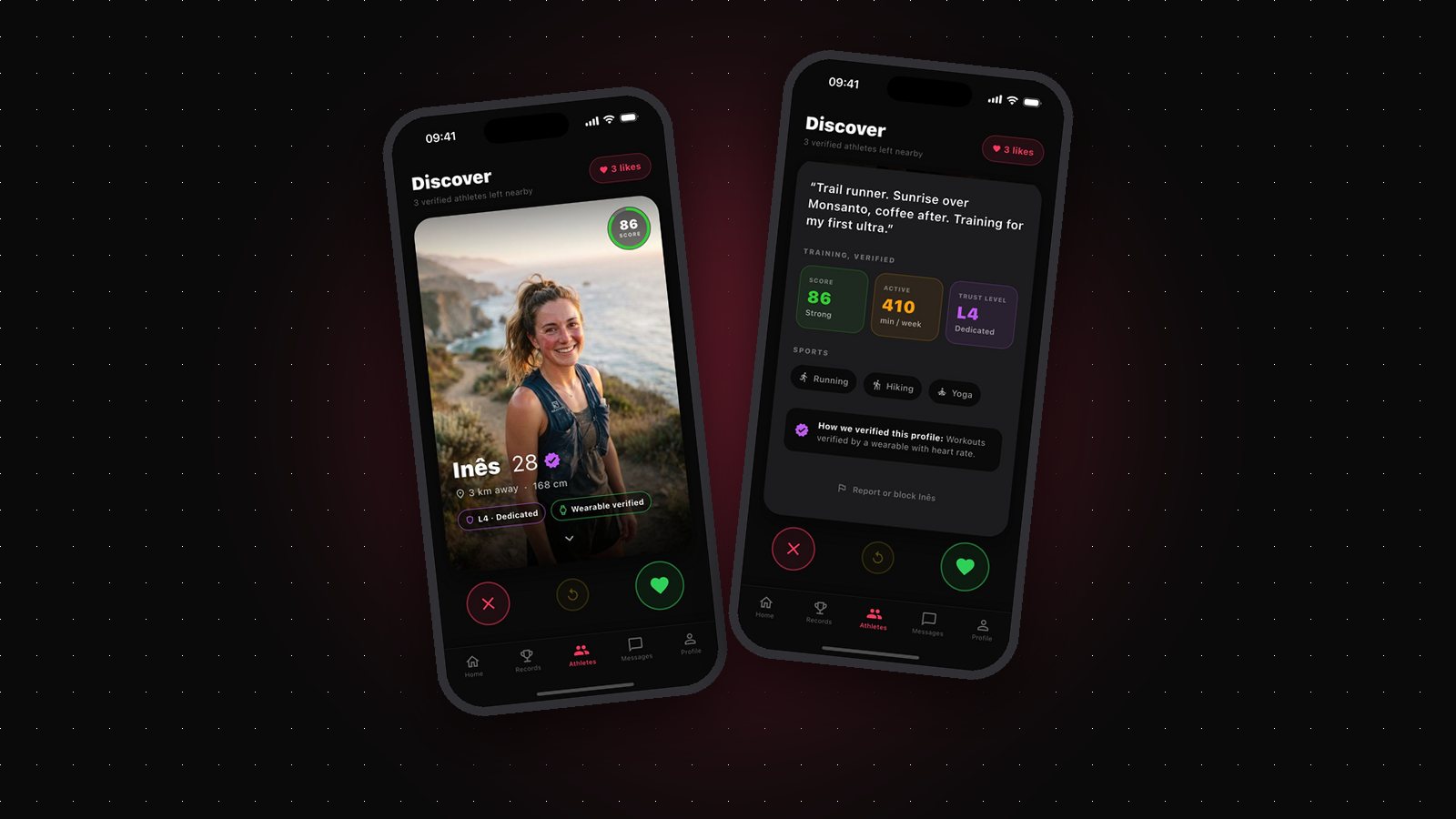
On most dating apps, your profile is a set of claims: photos you chose, prompts you polished, interests you tapped. Gritvit is built on a different input — your actual workout history — and that changes how matching works from the ground up.
Here's the full picture: what gets you into the pool, what other people see, and what keeps your profile visible once you're in.
Step one: earn your way in
Matches unlock only when your real activity clears one of three goals: 150 active minutes a week (averaged over 14 days), 4 workouts in the last 14 days, or 50,000 steps in the last 7 days. Already active? Onboarding reads your last 30 days, so you unlock on day one. That single gate is why the Gritvit pool looks different from any mainstream app: everyone in it has verified activity behind their profile.
The data comes from an app you already have. Gritvit reads workouts from Apple Health on your iPhone — Apple Watch, Garmin, and Fitbit sessions all count, and so do GPS workouts tracked with just your phone. Nothing is logged manually, so nothing can be typed into existence.
What every profile shows
Alongside the usual photos and details, every Gritvit profile carries two verified signals. The Fitness Score reflects recent training volume and consistency — it tells you whether someone is active right now, this month, not in some unspecified past. The Trust Level (L1 to L5) tells you how credible that data is: everyone starts at L1, GPS-verified outdoor workouts from your phone can reach L3, and the L4 and L5 tiers require a wearable with heart-rate data.
Read together, the two signals answer the questions a bio never can. "Is this person actually training?" — check the Fitness Score. "Can I believe it?" — check the Trust Level.
Your deck is ranked on what makes active couples work: shared sports count most, then how similar your fitness is, then distance and age — and people who already liked you get a boost. Like or pass; a mutual like opens the chat, and chat is free for everyone.
Staying visible is part of the deal
Matching on Gritvit isn't a one-time unlock — the gate is checked continuously. Your Fitness Score is a living number, and it reacts when you stop: around day 3 of inactivity it starts to decay and you get a warning, from day 5 your matches start pausing and you're hidden from other people's decks, and by day 8 the score resets. Get back above any one of the activity goals and your matches come back.
That sounds strict until you see what it buys you. On other apps, a profile can sit in the deck for months after its owner stopped living the life it advertises. On Gritvit, visibility tracks reality — the profiles you're shown belong to people who are training now. The decay isn't a punishment; it's what keeps every match current.
What stays on your phone
All of this runs without your raw health data leaving your phone. Scoring happens on-device: raw workouts, heart-rate readings, GPS routes, and step logs stay put. What's saved to your profile is summary numbers only — your Fitness Score, Trust Level, weekly active minutes, whether you use a wearable, and personal-record totals for the leaderboard. Other users see your scores and badge, never your raw data, and none of it is sold or shared.
So the matching system knows just enough about your training to prove it's real. Everything else stays yours.
Why this produces better matches
Every layer of the system — the activity gate, the verified signals, the decay — pushes toward the same outcome: a pool where fitness compatibility is measured, not claimed. You spend less time interviewing strangers about whether they really run and more time talking to people whose lifestyle already matches yours.
It's a smaller pool than the mainstream apps, and deliberately so. The filter is the product.